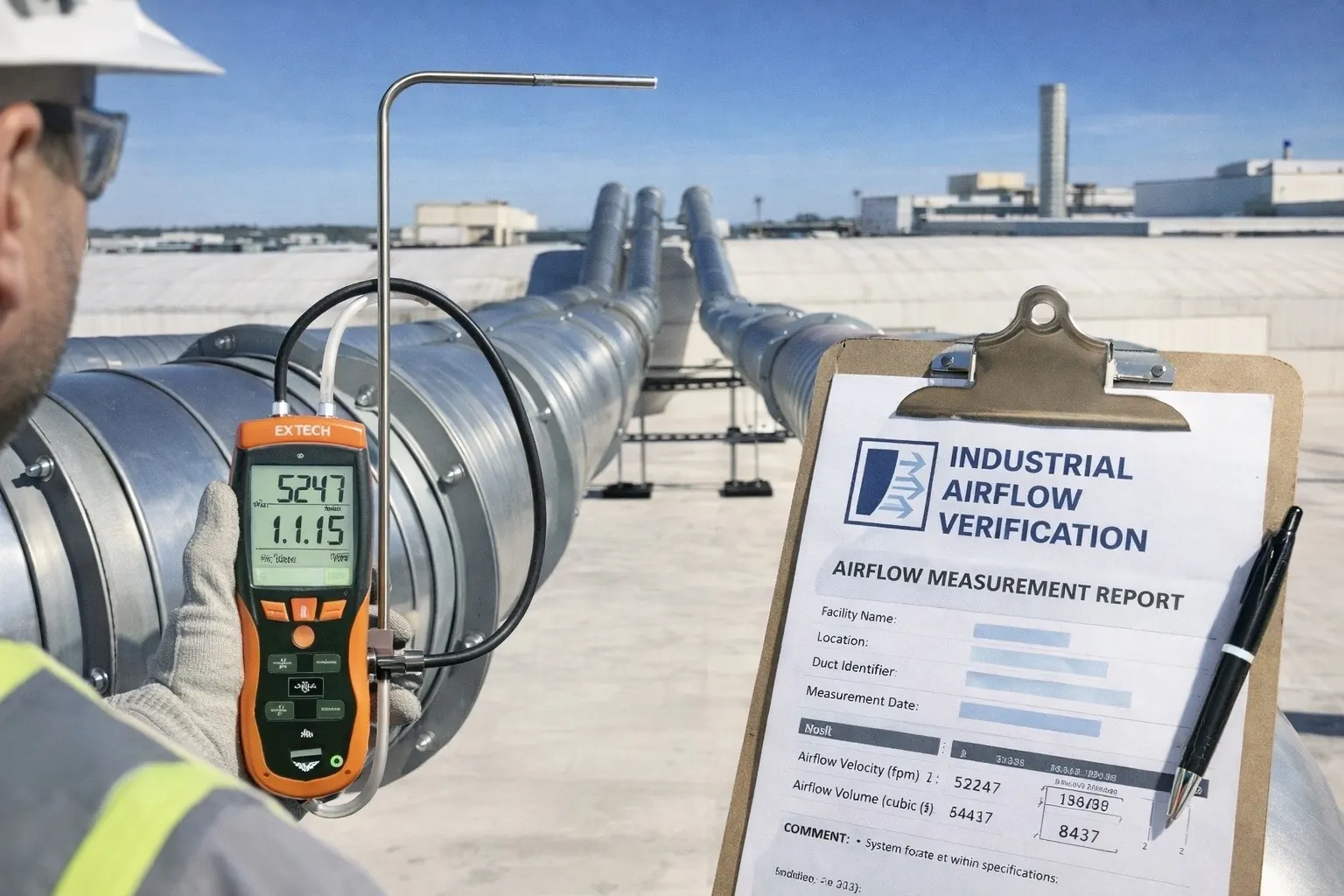
Airflow measurement using a pitot tube and digital manometer with a documented airflow report on an industrial rooftop

Independent measurement & reporting

Verify airflow performance with clear, defensible numbers.

We provide on-site airflow verification and dust collection performance reviews for industrial facilities— using practical measurement methods and reporting you can hand to operations, EHS, or management.

Serving Southwestern Ontario USA travel (case-by-case) Pitot tube CFM verification Dust collection + LEV testing Photo + data reporting Scoped recommendations

Who this is for

If your facility relies on dust collection, fume extraction, or process exhaust, we help you confirm what the system is actually doing—using clear measurements and a report your team can act on.

Typical industries

  • Metal fabrication, welding, grinding, and cutting
  • Woodworking and engineered wood products
  • Food processing and bulk material handling
  • Plastics, composites, and general manufacturing
If you have airborne dust, fumes, odours, or a process exhaust system, the measurement approach is usually transferable.

Common reasons teams call us

  • “Suction feels weak” or dust/fumes escaping at pickup points
  • Filters plugging frequently or maintenance costs climbing
  • New dust collector or ducting installed—need independent validation
  • After adding equipment/branches, existing pickups underperform
  • Upcoming EHS / insurer audit—need defensible documentation
If you’re not sure what to measure, we start with a short scope call and a walkdown.

Industries & facilities we support

We work across the major industrial sectors in Southwestern Ontario. Below are common facility types where dust collection, local exhaust ventilation (LEV), make-up air balance, and fan performance verification are frequently needed.

Automotive assembly & parts (Tier 1/2) welding fumes • grinding • paint/booth balance
  • Welding fume extraction verification (robotic & manual cells)
  • Grinding/finishing dust collection performance checks
  • Paint/process exhaust and make-up air (MUA) balance issues
  • Post-line-change validation to confirm new branches don’t starve existing pickups

Common triggers: line expansions, “weak suction” complaints, corporate EHS audits, or project close-out sign-off.

Metal fabrication, welding, cutting & machining fume capture • plasma/laser • central collectors
  • LEV hood airflow checks for welding, cutting, and fume extraction
  • Dust collection verification for grinding, deburring, polishing
  • Branch/main CFM verification to identify restrictions and imbalance
  • Troubleshooting chronic “it never worked right” systems

Common triggers: filters plugging, new machines added, nuisance dust, or inspector documentation requests.

Food & beverage processing ingredient dust • odours • building pressure
  • Ingredient handling dust capture (flour, sugar, spices, powders)
  • Process exhaust and odour capture verification
  • Make-up air and building pressure balance (infiltration/comfort)
  • Audit-ready documentation formats for internal EHS programs

Common triggers: audit preparation, odour complaints, “doors won’t close”, or expansion without rebalancing airflow.

Woodworking & engineered wood products high-volume dust • transport velocity • fire risk
  • Dust collection CFM verification across multiple machines/drops
  • Transport velocity checks to reduce settling/plugging risk
  • Identification of bottlenecks (flex, blast gates, restrictions)
  • Periodic verification programs to track performance drift

Common triggers: housekeeping burden, fire risk concerns, chronic plugging, or insurer questions.

Plastics, rubber & composites process fumes • trimming dust • odours
  • Process fume capture and LEV verification at equipment
  • Dust capture at trimming, sanding, and finishing stations
  • Make-up air interactions with process exhaust
  • Practical troubleshooting of inconsistent performance

Common triggers: odour migration, operator exposure concerns, or “works only when doors are open”.

Chemical, petrochemical & specialty materials process exhaust • safety reviews • documentation
  • Process exhaust airflow and static pressure verification
  • Local capture at transfer/handling points
  • MUA and building balance checks around high-exhaust operations
  • Defensible reporting for insurers, safety reviews, and audits

Common triggers: safety reviews, insurance audits, process changes, or odour/exposure issues.

Bulk material handling & ingredient facilities transfer points • conveyors • bag dumps
  • Transfer point dust capture verification (dump/transfer stations)
  • Conveyor enclosure exhaust performance checks
  • Bag dump station airflow verification and hood capture checks
  • Post-modification validation after adding branches/equipment

Common triggers: visible dust during transfer, cleanup burden, or upcoming risk reviews.

Packaging, paper & consumer goods line changes • trim dust • balance issues
  • Dust capture verification at trim/scrap points
  • Exhaust vs supply checks when lines change or speeds increase
  • Fan/blower performance verification after retrofits
  • Repeatable reporting for multi-line facilities

Common triggers: new equipment installs, comfort complaints, or energy penalties from imbalance.

Heavy equipment, machinery & industrial assembly large hoods • long duct runs • fan curves
  • LEV verification for welding/cutting and assembly processes
  • Airflow + static pressure checks to confirm operating point
  • Identify restrictions, imbalance, or control/throttling issues
  • Independent post-install validation and close-out reporting

Common triggers: “system should be stronger”, noise/vibration complaints, or contractor dispute resolution.

Industrial warehousing & distribution (process exhaust) battery rooms • packaging • pressure balance
  • Battery charging area exhaust verification (where applicable)
  • Packaging-related dust capture and exhaust checks
  • Building pressure balance when large exhaust systems operate
  • Audit-ready documentation and baseline records

Common triggers: odour migration, pressure complaints, safety audits, or facility expansions.

Not sure where your facility fits? If you have airborne dust, fumes, odours, or process exhaust—our measurement approach is usually transferable.
Services

Measurement and reporting first, with a light touch of consulting—focused on practical next steps. We’re not a contractor and we’re not commission-driven.

Dust collection performance verification

CFM measurements, capture checks, and bottleneck identification to confirm real suction where it matters.

Local exhaust ventilation (LEV) testing

Hood airflow and capture effectiveness checks for fume extraction, welding, grinding, and process exhaust.

Make-up air + building pressure balance

Verify supply vs. exhaust, diagnose negative pressure issues, and document practical corrections.

Fan & blower performance verification

Confirm operating point vs fan curve using measured airflow and static pressure—especially after complaints or retrofits.

Post-install / post-modification validation

Independent sign-off after new ducting, new branches, collector changeouts, or equipment additions.

Ventilation troubleshooting (root cause)

When “it never worked right”—measure, isolate causes, and prioritize fixes without upsell pressure.

Want a clearer list of examples? See What we verify.

What we verify

These are common, specific requests we see from industrial facilities. If you have a chronic problem or a new install you want validated, we can scope the right measurement points and produce a report you can hand to operations, EHS, management, insurers, or contractors.

Dust collection performance verification CFM • capture • transport velocity
  • Airflow (CFM) measurement at key branches and mains (where access allows)
  • Capture checks at hoods / pickup points and identification of weak zones
  • Transport velocity checks to identify settling / plugging risk
  • Bottleneck identification (blast gates, flex, restrictions, fan limitations)
  • Clear scope for “try first” fixes vs larger changes

Common triggers: “suction feels weak”, dust escaping, filter plugging, or a system that “never worked right”.

Local exhaust ventilation (LEV) testing hood airflow • capture effectiveness
  • Hood airflow measurements and quick capture checks
  • Smoke / tracer visualization (where appropriate) to understand airflow path
  • Static pressure checks to identify hidden restrictions
  • Documentation suitable for internal EHS programs or audits

Common triggers: welding fumes, grinding dust, odour complaints, or “it only works when the doors are open”.

Make-up air (MUA) and building pressure balance supply vs exhaust • infiltration
  • Supply vs. exhaust balance checks to diagnose negative/positive building pressure
  • Assessment of make-up air unit delivery vs. design intent
  • Identify interactions between process exhaust and HVAC
  • Practical recommendations (sequence/controls, obvious restrictions, operating setpoints)

Common triggers: doors hard to open, cold drafts, odours, comfort complaints, or backdrafting concerns.

Fan & blower performance verification static pressure • operating point
  • Airflow + static pressure measurement to locate the operating point
  • Comparison to fan curve (where available) to spot mismatch
  • Identify throttling, restrictions, or obvious control issues
  • Support for warranty discussions or contractor dispute resolution

Common triggers: noise, vibration, “it should be stronger”, recent retrofits, or escalating maintenance costs.

Post-install / post-modification airflow validation commissioning • independent sign-off
  • Baseline measurements before changes (optional)
  • Independent verification after ducting changes, new branches, or collector swap
  • Confirm new work didn’t starve existing pickups
  • Concise documentation for project close-out

Common triggers: new equipment added, new duct runs, collector changeouts, or a project that needs sign-off.

Compliance & documentation support defensible records • audits
  • Baseline airflow records for internal audits or risk reviews
  • Clear measurement point IDs and photo documentation
  • Reporting that clarifies assumptions, constraints, and limitations
  • Repeatable format for multi-site programs

Common triggers: insurer questions, new EHS leadership, corporate audits, or “we need proof”.

Ventilation troubleshooting (root cause) measure • isolate • prioritize fixes
  • Field measurements to separate symptoms from causes
  • Identify restrictions, imbalance, or control issues driving poor performance
  • Prioritized “do this first” recommendations (no upsell)
  • Optional follow-up verification after changes

Common triggers: chronic complaints, dust escape, inconsistent performance by shift, or a system that has had multiple “fix attempts”.

Periodic airflow verification & preventative audits baseline • trend • recurring
  • Annual or bi-annual rechecks of key measurement points
  • Trend tracking versus baseline to catch drift early
  • Repeatable reporting format across sites
  • Lightweight audit-ready documentation

Common triggers: preventative maintenance programs, corporate EHS requirements, or a desire to reduce surprise failures.

Typical industries

  • Metal fabrication, welding, grinding, and cutting
  • Woodworking and engineered wood products
  • Food processing and bulk material handling
  • Plastics, composites, and general manufacturing
If you have airborne dust, fumes, or a process exhaust system, the measurement approach is usually transferable.

What you can send us

  • Any existing drawings (even if outdated)
  • Fan curve / model info, if available
  • List of “problem areas” and operating schedule
  • Safety requirements and escort needs
Don’t worry if you have nothing—most projects start with a short scope call and a walkdown.

Method

We use established field measurement practices. A typical airflow verification uses a pitot tube and a measured traverse to estimate velocity profile and calculate flow.

How it works

  • Define measurement points and access constraints
  • On-site verification and documentation
  • Compute airflow from measured velocity data
  • Summarize findings with context and assumptions

A note on technical detail

We keep the report content as simple as possible. The report includes the technical detail needed for decision-making (measurement points, assumptions, and calculation basis), without turning into a textbook.

Pitot tube Velocity traverse CFM calculation

Deliverables

Designed to be readable, specific, and defensible.

Measurement summary

Results by measurement point, with any constraints clearly stated.

Findings & bottlenecks

Observed issues that explain performance, prioritized by impact.

Practical next steps

Recommendations with scope clarity (what to try first, and why).

Typical applications

  • “Feels weak” suction complaints
  • Dust collector changeouts / upgrades
  • New ducting runs or modifications
  • Maintenance-driven performance drift
  • Pre / post verification after changes

What we don’t do

  • Open-ended consulting retainers
  • Commission-based upsells
  • Vague opinions without measurement/observation

Pricing

Transparent, scoped work. Final pricing depends on access, complexity, and travel.

Standard site review

From $3,500 per site

  • Scope call + measurement plan
  • On-site verification & documentation
  • Concise PDF report
Need a recurring program across sites? We can standardize formats and cadence.

Follow-up verification

From $1,500 per visit

  • Re-check key points
  • Confirm improvement vs baseline
  • Short addendum report
Ideal after maintenance changes or retrofit work.

Service area

Primary service area is Southwestern Ontario. Travel elsewhere in Ontario and into the United States may be available on a case-by-case basis depending on scope and schedule.

Southwestern Ontario (primary)

  • Windsor–Essex, Chatham-Kent, Sarnia-Lambton
  • London, St. Thomas, Woodstock, Ingersoll, Elgin & Oxford County
  • Kitchener-Waterloo, Cambridge, Guelph
  • Hamilton, Brantford, Niagara Region
  • Greater Toronto Area (GTA): Mississauga, Brampton, Vaughan, Markham, Oakville, Milton, Burlington
  • Toronto, Scarborough, Etobicoke, North York
Not listed? Send your city—we often travel within the region.

USA travel (case-by-case)

We can support U.S. sites when it makes sense (for example: multi-site programs, repeat clients, or projects near the border). We'll confirm feasibility during the scope call.

  • Border-near manufacturing and distribution facilities
  • Multi-plant programs with repeatable reporting
  • Post-install verification for capital projects

FAQ

Quick answers to common questions about airflow testing, access, and reporting.

What standards do you follow? practical field measurement

We use established field measurement practices (pitot tube traverses, static pressure readings, and clearly documented assumptions). If you have an internal standard or a project spec, we align the report format and measurement plan to it.

Do you provide design or sell equipment? independent

No. We focus on measurement, verification, and clear documentation. Recommendations are scoped and prioritized, but we don't sell equipment or work on commission.

Do you work with our contractor or engineering firm? independent verification

Yes. We can coordinate measurement points and reporting needs with your contractor or engineer, while remaining vendor-neutral. Many clients use our report to validate work and close out projects with clear documentation.

Where do you work? Southwestern Ontario + USA case-by-case

Our primary service area is Southwestern Ontario. Travel elsewhere in Ontario and into the United States may be available on a case-by-case basis depending on scope and schedule.

What do you need from us to start? scope call

A short call to understand the problem, followed by a quick list of measurement points and access constraints. Drawings and fan info help, but many projects begin with a walkdown.

How long does a typical site take? 1–3 days typical

Many sites can be measured in a day with reporting shortly after. Larger facilities or complex systems may require multiple days. We'll quote based on access, number of systems, and travel.

Request a Quote

Tell us what you want verified and where. We’ll respond with a scoped plan and a clear price. Primary service area is Southwestern Ontario; U.S. travel may be available on a case-by-case basis.

No spam. Your info is used only to respond to your request.

What happens next

  • 1 business day reply to confirm scope and access constraints
  • A short measurement plan (what we’ll check, and where)
  • A clear quote, including travel if applicable
  • Scheduling options that fit production constraints

Prefer direct contact?

Email is best for attaching drawings or photos.

Email LinkedIn